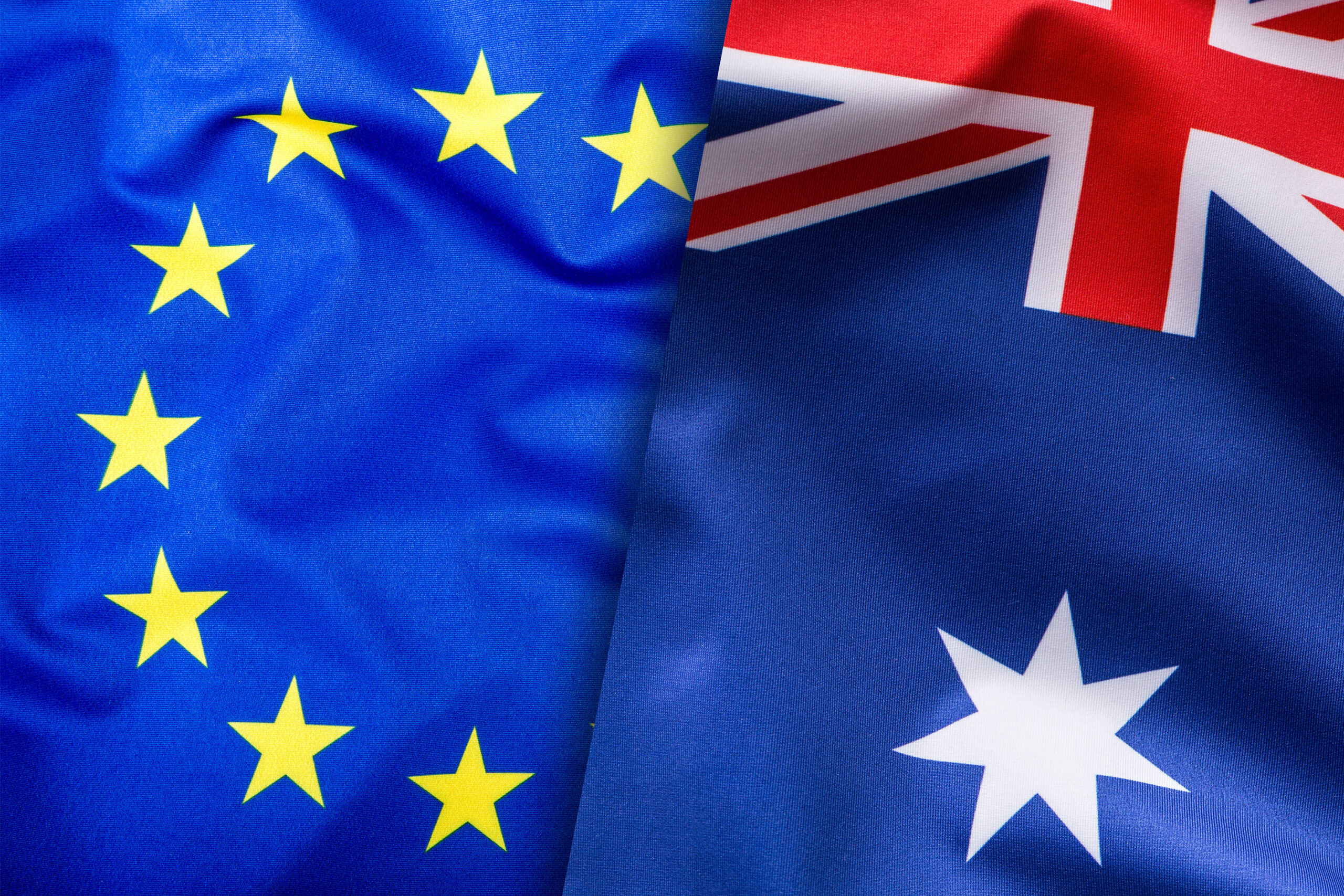
The European Union and Australia have announced* three major developments that will shape cross-border opportunity over the coming years: the conclusion of negotiations for an EU–Australia Free Trade Agreement (FTA), the launch of formal negotiations for Australia’s association with Horizon Europe (the EU’s flagship research and innovation funding program), and the adoption of a new EU–Australia Security and Defence Partnership.
These steps sit in a broader shift toward supply-chain resilience, economic security and deeper cooperation between like-minded partners in a more uncertain geopolitical environment.
The agreements matter because they reduce friction in trade, create clearer pathways for research and innovation collaboration, and strengthen strategic alignment in areas that affect business reality such as supply chains, cyber and critical technologies.
What’s been agreed
1) EU–Australia Free Trade Agreement: negotiations concluded
The FTA is designed to make it easier, and often cheaper, for organisations to trade and operate across the EU and Australia. It includes tariff reductions (and, at full implementation, near-total tariff elimination across most goods lines), alongside commitments that support services, investment and modern trade rules.
The FTA improves access to EU government procurement markets. That means Australian organisations (including SMEs) will have better access to bid for EU government contracts (estimated at around $845 billion annually) including major categories like rail and construction.
While negotiations are concluded, the agreement still needs to move through legal checks, translation, signature and parliamentary processes. DFAT expects signature in late 2026 or early 2027, with additional domestic processes after signature expected to take up to another year – so, in practical terms, ratification and entry into force may take another year or two yet.
The point isn’t to wait. It’s to prepare now so you can move quickly as the agreement comes into effect.
2) Horizon Europe: formal negotiations to associate Australia
Horizon Europe is the EU’s flagship research and innovation program (worth about AUD $155 billion) and association would give Australian organisations a more direct pathway to participate in EU-backed research and innovation projects at scale.
Association is the closest form of science and innovation cooperation the EU offers a non-EU country. It enables eligible Australian organisations to apply into Horizon Europe calls, collaborate with EU and other associated-country partners, and (in many cases) lead or participate in multi-party projects across priority areas such as critical technologies, advanced computing, climate and clean energy, health, critical minerals and supply chain security.
Who it impacts:
- startups and scale-ups seeking faster R&D and commercialisation pathways
- research institutes and universities expanding collaboration networks
- private companies (including SMEs) building partnerships and evidence pipelines
- publicly listed companies investing in innovation, market access, and strategic partnerships
- industry consortia tackling complex problems that require multi-party capability
The Australian Government expects that, following the treaty process, Australian organisations would be able to apply for Horizon Europe calls from early 2027 (often described as coming into effect in 2027).
3) Security and Defence Partnership: a new framework for cooperation
This partnership is now in effect and establishes a structured framework for deeper cooperation. In practical terms, it strengthens coordination in areas that influence investment confidence, supply chains and security settings for critical industries.
The Australian Government has described the partnership as wide-ranging, with cooperation spanning defence industry, cyber, economic security, counter-terrorism, countering hybrid threats, increased information sharing, and even a new space security dialogue.
For business, one direct implication is that it creates additional defence procurement opportunities and strengthens the “trust architecture” that often determines where capital flows, how supply chains are designed, and which partners are viewed as credible in sensitive or regulated sectors.
What it means for organisations and businesses
1) Lower friction for trade, expansion and operating across markets
Tariff reductions matter, but the broader benefit is clarity and reduced friction: product lines, pricing, compliance and go-to-market approaches can be planned with greater certainty as implementation details are confirmed.
2) Access to EU government procurement (not just “big business” access)
This is significant because it opens a path for Australian organisations of all sizes, including SMEs, to compete for EU government procurement opportunities. That can be a major growth lever for organisations in sectors like infrastructure, rail, construction, technology, services and specialised manufacturing.
3) De-risking supply chains and diversifying markets
A key strategic benefit is optionality. For many organisations, these agreements support:
- diversifying revenue away from a single market
- de-risking supply chains (especially in critical inputs and advanced components)
- building more resilient operating models by widening partnership and sourcing options
4) Faster pathways from research to commercial outcomes
Horizon Europe is not just “research funding”- it’s a mechanism for building cross-border consortia that can accelerate evidence generation, product development, regulatory readiness and commercialisation. For innovation-led sectors (medtech, biotech, cleantech, advanced manufacturing, critical minerals, cyber and deep tech), it can materially shorten the distance between R&D and market entry if organisations are ready to participate effectively.
5) Accessing new sources of funding and collaboration
For many Australian organisations, association to Horizon Europe would represent access to collaboration and funding pathways that haven’t previously been available at this scale – particularly when partnering with EU institutions and industry players already structured to work through Horizon calls.
6) A stronger security and defence operating context
The Security and Defence Partnership will shape how some industries plan risk, cyber posture, compliance, and cross-border partnerships. This is especially true for organisations operating in critical infrastructure, defence-adjacent manufacturing, sensitive technology, or highly regulated environments.
Ratification may take time. Preparation shouldn’t.
While ratification could take up to two years end-to-end, the organisations that will benefit most are likely to be those that start preparing now.
By clarifying market fit, building partnerships, understanding regulatory settings early, and ensuring your organisation has the ability to execute internationally (operationally, not just strategically), will position you ahead of your competitors.
A Discovery Call can help determine the best course of action to prepare for what’s ahead.
A practical next step
If your organisation is considering EU–Australia expansion, R&D partnerships, or supply-chain and regulatory planning, Small and Mighty Group can help you align:
- strategy and value proposition
- operating model, governance and risk
- execution planning and capability to deliver
Through our subsidiary, Nord South Partners, we work with organisations to align strategy, leadership and execution, particularly during periods of change, growth and complexity. Nord South Partners is your closely aligned partner that focuses on cross-border commercialisation and implementation between Northern Europe and Australia, helping organisations translate opportunity into practical entry and delivery in-market.
Together, we support organisations looking to act on the momentum created by the EU–Australia announcements by combining strategic clarity with locally grounded execution. That includes shaping market entry strategy, building the right collaborative partnerships, navigating new regulatory and cultural environments, and supporting delivery to capitalise on the opportunities ahead.
*Sources: https://ec.europa.eu/commission/presscorner/detail/en/ip_26_645, https://nordsouthpartners.com/