
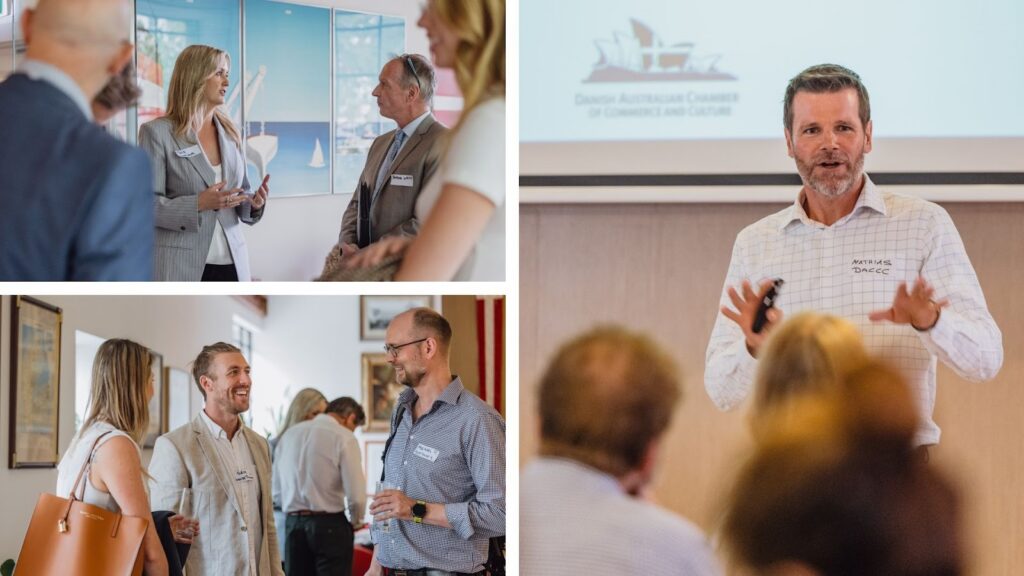
The Danish–Australia Executive Dialogue was held at Denmark House in Melbourne on 16 March, discussing North–South opportunities on the opening day of Denmark’s state visit program. The event was co-created by Small and Mighty Group and Nord South Partners, together with the Danish Australian Chamber of Commerce and Culture. Its purpose was practical: to bring Nordic and Australian organisations together to explore real pathways for collaboration, market entry and delivery.
The Dialogue brought together businesses from a broad cross-section of industries and geographies, reflecting the wider delegation activity occurring across the week. It was intentionally designed to extend the conversation beyond a single sector focus and to make space for organisations that do not always get visibility in formal trade programs, despite often being well positioned to act on emerging opportunities.

The session also provided economic and strategic context. Jason Collins, CEO of the European Australian Business Council (EABC), opened with a briefing on the current landscape and the implications of geopolitical fragmentation and supply chain vulnerability. His central message was clear: the right response is not to retreat from openness, but to redesign it by diversifying toward like-minded and trusted partners.
Presentations by Mathias Grüttner, Managing Director of Napica, and Torben Soelvsteen, Co-CEO of Nord South Partners, focused on what cross-border engagement requires in practice, including trust, local market understanding, the structural gaps that stall market entry, and what it takes to position an expansion strategy for long-term success rather than short-term presence.
Below is a summary of the key themes that emerged, with a focus on what organisations often underestimate and what materially improves the likelihood of successful Australia–Nordic collaboration.
Why the timing matters
A consistent observation from the Dialogue was that future growth cannot be solved using an insular, country-by-country approach. Climate change, supply chain risk and technology transfer increasingly demand global thinking, and that is pushing organisations to reconsider where they build partnerships and where they invest.
From a commercial perspective, the Australia–Nordic corridor has been estimated to represent a $30 billion opportunity in green energy and sustainable infrastructure alone, before additional sectors such as life sciences, advanced manufacturing, defence, digital services and agrifood are considered.
What each side offers
What Australia offers Northern Europe
The Dialogue highlighted several reasons Australia is an attractive market and partner for Nordic businesses. These include a large, stable and growing economy, an industry landscape that can be less constrained by heavy regulation and tradition, ambitious renewable energy targets, and a market of 27.6 million people and rising.
What the Nordic countries offer Australia
Northern Europe offers world-leading green technologies and products that can help Australian organisations close the sustainability gap and meet government targets faster. It also offers regulatory environments that, in many sectors, are already where Australia is heading. For Australian organisations looking beyond the domestic market, Northern Europe also provides access to a larger B2B market and a strong base for international scale.
The gap that still needs closing
Across the week’s conversations, one theme kept returning. Many organisations have brilliant products, strong IP and genuine ambition. What they often lack is a safe, structured and scalable pathway into the other market.
A particularly common challenge is the distance between strong IP and commercial readiness. Australia has world-class research institutions and strong pipelines across biotech, cleantech, medtech and advanced manufacturing. The constraint is rarely capability. More often, it is the transition from R&D mode to commercialisation mode, which is frequently under-resourced and under-timed.
This is a key reason Nord South Partners was created as a subsidiary of Small and Mighty Group. It was built to provide the flexible, structured support organisations need to understand a new market, navigate cultural and commercial differences, and avoid being locked into rigid packages.
Market entry realities that are easy to underestimate
Australia is not one market
A major point made in Torben Soelvsteen’s address was that Australia often behaves like several markets that happen to share a currency. State differences can shape regulatory expectations, procurement processes, industry priorities and relationship networks. A contract in one state does not automatically translate to credibility in another.
The reverse is also true. A footprint in Denmark does not automatically translate across Norway or Sweden. Cross-border growth requires a local-global approach, supported by the right partner on the ground.
Trust is local
The Dialogue reinforced that even when organisations are values-aligned and communication feels easy, deals are often won on local trust. People tend to do business with people they know, or people recommended by someone they trust. Getting the right local voice behind you is often the difference between a deal and a door that stays closed.

What “good” looks like in practice
Cross-border growth succeeds when organisations treat entry as a staged delivery program, not a single decision. Practical examples discussed at the Dialogue included structured market analysis, prioritising the right entry points, building warm introductions through trusted networks, and supporting delivery once traction begins.
Different industries and different directions still require the same fundamentals: clarity, local insight, and delivery capability that adapts as reality changes. If you are an organisation who would like to understand more about what cross-border growth could mean for your business, book a Discovery Call today with our team.
How Small and Mighty Group and Nord South Partners support organisations
Small and Mighty Group supports organisations to align strategy, leadership and execution, especially during growth, change and complexity. Nord South Partners compliments this by focusing on cross-border commercialisation and implementation between Northern Europe and Australia, helping organisations move from intent to structured entry and in-market delivery.
If you are exploring opportunities across the Australia–Nordic corridor, a useful first step is practical clarity. Define the outcome you want, identify what must be true to succeed, and build a staged plan to execute.